
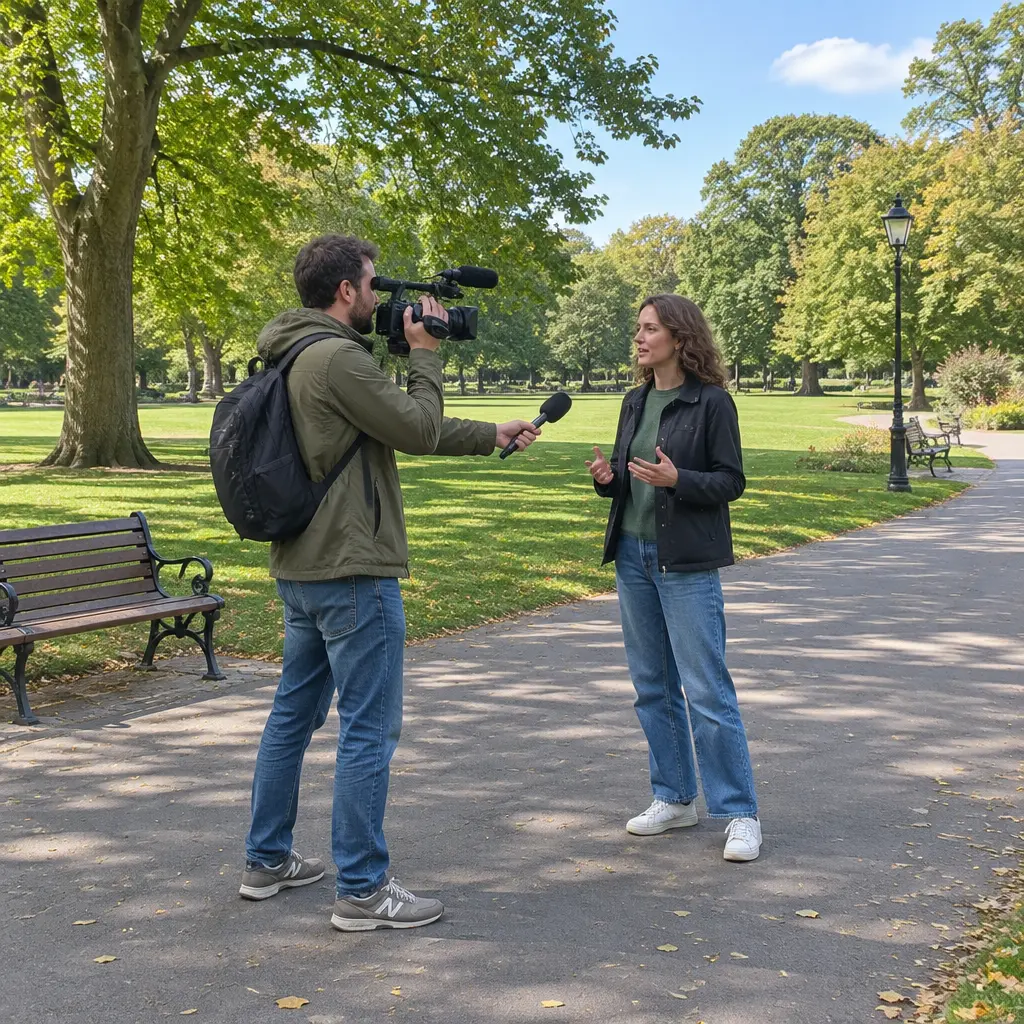
A solo video journalist is a reporter who gathers, records, and often edits video stories largely on their own, combining traditional reporting with camera, audio, and digital-production skills. The role has grown as smartphones, lightweight cameras, and online publishing have lowered production barriers, while audiences increasingly consume news on digital platforms. The U.S. Bureau of Labor Statistics counted about 54,000 news analysts, reporters, and journalists in 2023, a broad occupational group that includes multimedia journalists; its projected employment change for the group was a decline of 3% from 2023 to 2033. These pressures help explain the appeal of the one-person workflow—and its trade-offs. This article defines the role, traces its technological and economic rise, examines working practices and risks, and considers examples and the future of solo video journalism.
Solo Video Journalist: Role, Skills, and Scope
“Solo video journalist” is a practical industry term rather than a standardized job-title category. It describes a journalist who performs multiple parts of video-story production—typically reporting, shooting, sound recording, and editing—without a separate crew for each task. The International Journalists’ Network’s guidance on mobile journalism describes a closely related practice: using portable devices and apps to report, film, edit, and publish from the field.
The label covers several overlapping forms, including mobile journalism, video journalism, multimedia reporting, and one-person-band reporting. These are not always identical: a mobile journalist is defined by the use of mobile tools, while a solo journalist is defined by the concentration of production duties in one person. A video journalist may work alone on some assignments and with a crew on others.
A hybrid reporting and production role
A solo video journalist must make editorial decisions while also managing technical execution. A typical assignment can involve pitching a story, researching and interviewing sources, recording synchronized picture and sound, capturing contextual footage, writing narration or captions, editing, checking facts, and delivering versions suited to different platforms. The central distinction is not simply that the journalist carries a camera; it is that one person is responsible for integrating reporting and production.
The U.S. Bureau of Labor Statistics describes reporters and journalists as people who research, investigate, interpret, and communicate news. Video work adds production competencies to those duties. This combination can make a journalist more adaptable, but it also means that every additional technical task competes with time for interviews, observation, verification, and reflection.
Common formats and hyponyms
The solo-video category includes several narrower formats. A “one-person band” commonly handles reporting and production for a conventional news package. A mobile journalist, or “mojo,” reports with a smartphone-centered kit. A video correspondent may file short stand-ups and interviews from a location, while a documentary journalist may work alone during some stages of a longer investigation but rely on editors or producers later. Social-video reporters make vertical or short-form pieces for platform feeds, often adapting a story into several cuts.
These formats share a compact workflow but differ in duration, audience, equipment, and editorial support. A short mobile update may be assembled quickly; an investigative film still requires substantial verification, legal review, and editorial oversight. “Solo” therefore describes the field-production arrangement, not necessarily the entire chain of responsibility.
Technology and Economics Behind the Rise
The rise of solo video journalism reflects two linked changes: production equipment has become smaller and cheaper, and news distribution has shifted toward digital platforms. The Reuters Institute for the Study of Journalism’s Digital News Report 2024, based on surveys across 47 markets, found that social media and video platforms are important routes through which many people encounter news, particularly younger audiences. Platform use does not guarantee trust or sustained attention, but it gives publishers a strong incentive to produce video in formats designed for online discovery.
At the same time, news organizations have faced long-running financial pressures. The Pew Research Center’s 2024 analysis of U.S. newspaper employment reported that newsroom employment at newspapers fell by 77% between 2008 and 2020. That figure applies to newspaper newsroom jobs, not to all journalism employment, but it illustrates the contraction that has encouraged many outlets to seek leaner production models. Solo production can help a newsroom publish from more locations with fewer people, although it is not a substitute for adequate staffing or editorial investment.
Portable cameras, smartphones, and connectivity
A modern solo kit may include a smartphone or compact camera, a small tripod, an external microphone, headphones, portable lighting, batteries, storage cards, and editing software. A reliable microphone and careful sound monitoring are often more important to perceived quality than a high-end camera body. Cloud storage and mobile networks can also let reporters file footage or publish updates without returning to a newsroom.
The International Journalists’ Network has emphasized that mobile reporting depends on planning and practical technique, not merely owning a phone. Reporters must consider battery life, storage, data security, framing, exposure, and backup recording. Equipment access has widened participation, but good journalism still depends on source development, context, accuracy, and judgment.
Digital distribution and changing audience habits
Online distribution allows a video to appear on a news site, an app, a social platform, or a messaging channel, sometimes within minutes of an event. Reuters Institute research describes a fragmented news environment in which publishers compete with creators, influencers, and platform-native video. This encourages concise storytelling, subtitles, vertical framing, and versions tailored to different screens.
The same distribution model creates editorial risks. A video optimized for reach can lose context when clipped, detached from its original report, or presented through a platform’s recommendation system. Solo journalists and editors should preserve captions, dates, location information, and explanatory context so that a fast-moving clip remains understandable when shared outside its original setting.
Skills, Workflow, and Editorial Standards
Effective solo video journalism pairs technical competence with conventional reporting standards. The Committee to Protect Journalists’ safety guidance stresses that journalists should assess assignment-specific risks, prepare communications plans, and take steps to protect themselves and their material. A workable solo process therefore includes both a production checklist and an editorial checklist.
From story planning to field reporting
Before filming, a journalist should identify the story’s central question, the evidence needed to answer it, the people who can speak to it, and the risks involved. A shot list can help ensure that the finished piece has more than an interview: establishing images, relevant action, details, transitions, and natural sound all contribute to a coherent account. Interview preparation should include open questions, follow-ups, and a clear explanation of how the material may be used.
A solo reporter has limited attention while operating a camera and monitoring a scene. For sensitive interviews or volatile events, it may be safer and more accurate to prioritize listening and note-taking, or to bring a colleague. The ability to work alone should never be confused with an obligation to do so.
Sound, pictures, and editing
Clear sound is essential because viewers need to understand both the words and the circumstances in which they were spoken. Headphones help detect wind, handling noise, clipping, and interference while recording. Visual coverage should support the reporting rather than manufacture evidence: illustrative footage must not imply that an event occurred in a place or manner that it did not.
Editing should preserve meaning and chronology. Journalists should verify names, dates, quotations, and translations; retain original files; and distinguish actuality from illustrative or archival images. The Society of Professional Journalists’ Code of Ethics calls on journalists to seek truth, minimize harm, act independently, and be accountable and transparent. Those principles apply to video choices as much as to written copy.
Verification, consent, and accessibility
Video can appear persuasive even when its context is incomplete. Before publication, journalists should check when and where footage was recorded, whether it has been altered, and whether the people shown are correctly identified. User-generated clips require particular care: a video’s apparent realism does not establish its date, location, or provenance.
Ethical practice also includes informed consent where appropriate, careful treatment of vulnerable people, and attention to the consequences of revealing identities or locations. Captions and transcripts improve accessibility and help viewers who watch without sound. They also support comprehension across noisy environments and language barriers.
Benefits, Limits, and Safety Considerations
Solo production can make reporting more agile, but its efficiency is conditional. It works best when the story’s complexity, safety profile, and deadline fit one person’s capacity—and when the journalist has time and editorial support to verify the result.
Speed, access, and local storytelling
A journalist who can gather and file material independently may cover routine events, local issues, and unfolding developments without waiting for a full crew. A compact kit can also be less conspicuous than a large production setup, potentially helping a reporter work in confined or ordinary community settings. These advantages can widen the range of stories a newsroom is able to consider.
The format can support explanatory and community reporting as well as breaking news. A reporter might document a local public meeting, interview residents about a service change, or follow a public-interest issue over time. In each case, the value comes from sustained reporting and credible evidence, not from the camera’s portability alone.
Workload, safety, and production limits
Doing several jobs at once can increase cognitive load and reduce opportunities to notice important details. A journalist may miss a follow-up question while checking focus, or overlook a safety concern while monitoring a screen. Long hours, tight deadlines, and repeated solo assignments can also contribute to fatigue and burnout.
In hostile environments, protests, disasters, and conflict zones, working alone may create serious risks. The Committee to Protect Journalists recommends preparation that includes risk assessment, emergency contacts, communications procedures, and suitable training. News organizations should provide safety support and make clear that a reporter can pause or refuse an assignment when the risks are unacceptable.
There are also stories that benefit from a team. A second journalist can monitor surroundings, conduct an interview while another operates the camera, or provide an independent check on developing evidence. Complex investigations, sensitive interviews, and events with significant physical or legal risks may require a producer, camera operator, fixer, translator, or security specialist.
Examples and Applications in Practice
Solo video journalism is visible across local reporting, mobile-first newsrooms, and international coverage. Its forms vary by assignment, and many successful examples rely on collaboration behind the scenes even when one reporter appears to work alone in the field.
Mobile reporting in local news
A local reporter covering a council decision can record a short interview with an official, gather images of the affected site, and file a concise explainer from the location. This approach can make a story more immediate and visually grounded than a text-only update. The journalist still needs to consult documents, seek responses from affected parties, and explain what the decision changes for residents.
The example also shows why a video should not carry the entire burden of reporting. A short clip can introduce a development, while a linked article, caption, or follow-up report supplies details that cannot be responsibly compressed into a brief social post.
Field reporting during emergencies
During a flood, wildfire, or other emergency, a reporter may use a mobile kit to document conditions and speak with responders or residents. The same setting demands extra caution: journalists must avoid interfering with emergency operations, protect people in distress, verify rapidly changing information, and follow evacuation or access instructions. If reliable communication or personal safety cannot be maintained, publication speed should not take priority over safety.
A useful editorial practice is to label what is confirmed, identify what remains uncertain, and update or correct the report as information changes. This keeps a fast video dispatch from being mistaken for a complete account.
A visual reference for newsroom planning
A simple workflow chart could compare a solo assignment—planning, reporting, filming, editing, verification, and publication—with a team-based workflow in which those tasks are shared. A second chart could plot the trade-off between assignment complexity and the level of crew support needed. These visuals would make clear that solo reporting is most appropriate when workload and risk are manageable, not merely when equipment is available.
The Future of the Solo Video Journalist
The role is likely to keep changing as cameras, editing tools, automated transcription, and generative artificial intelligence become more accessible. Such tools can reduce routine production time, but they do not replace source verification, editorial judgment, consent, or accountability. Newsrooms will need transparent policies for synthetic media and clear procedures for checking the authenticity and provenance of footage.
The larger question is institutional: whether efficiency gains are reinvested in reporting quality or used simply to assign more work to fewer journalists. Sustainable solo video journalism requires training, realistic deadlines, secure equipment, editorial review, fair compensation, and the option to work with a team when a story demands it.
Conclusion: Solo Video Journalism as a Flexible but Demanding Practice
The solo video journalist combines reporting, camera work, sound, and editing in response to portable technology and digital distribution. Mobile journalism, one-person-band reporting, social video, and video correspondence are related forms, but they differ in tools, audience, and production demands. The model can improve speed and access, yet it also brings workload, verification, ethical, and safety challenges.
Its long-term value depends on journalism standards rather than production speed alone. Newsrooms and independent journalists should match staffing to the assignment, protect time for verification, and treat safety and accessibility as core parts of the workflow. For further reading, consult the Reuters Institute’s Digital News Report, the Society of Professional Journalists’ Code of Ethics, and the Committee to Protect Journalists’ safety resources.
Sources: U.S. Bureau of Labor Statistics, Occupational Outlook Handbook: News Analysts, Reporters, and Journalists, https://www.bls.gov/ooh/media-and-communication/news-analysts-reporters-and-journalists.htm; International Journalists’ Network, Mobile Journalism Resources, https://ijnet.org/en; Reuters Institute for the Study of Journalism, Digital News Report 2024, https://reutersinstitute.politics.ox.ac.uk/digital-news-report/2024; Pew Research Center, U.S. newsroom employment has fallen 26% since 2008, https://www.pewresearch.org/short-reads/2021/07/13/u-s-newsroom-employment-has-fallen-26-since-2008/; Committee to Protect Journalists, Safety Advisories and Resources, https://cpj.org/safety-advisories/; Society of Professional Journalists, SPJ Code of Ethics, https://www.spj.org/ethicscode.asp