
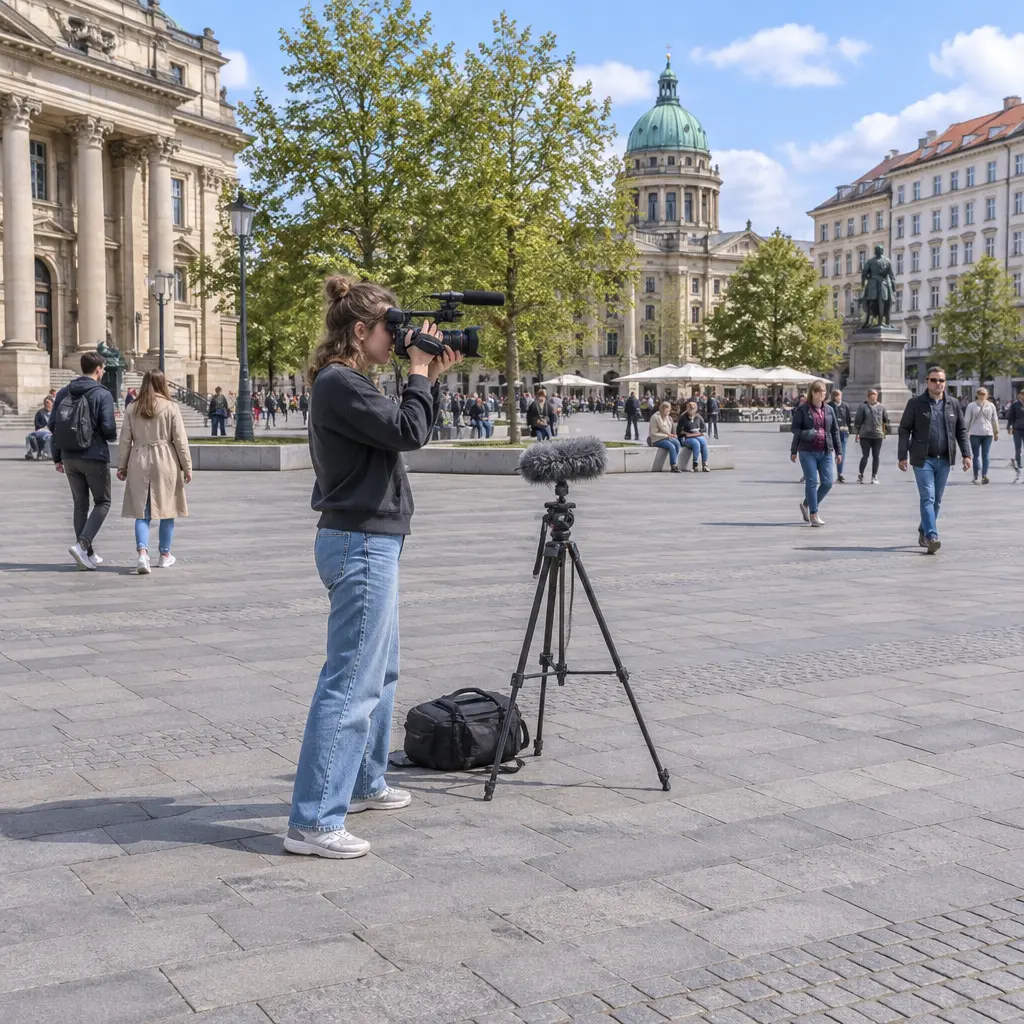
Video journalism is the reporting and verification of news through moving images, sound, and on-camera or narrated storytelling. It matters more than ever because audiences increasingly encounter news on screens and social platforms, while video can show events, explain complex issues, and help viewers assess evidence—provided that journalists verify what they publish. The Reuters Institute’s 2024 Digital News Report found that 66% of its surveyed respondents watched short news videos weekly, and 72% accessed video news through online platforms. This article examines video journalism’s public value, its distinctive formats, the standards that make it trustworthy, and the challenges posed by misinformation, artificial intelligence, and unequal access.
Video Journalism Builds Public Understanding
Video journalism is a form of news reporting that combines visual evidence, sound, context, and editorial judgment to inform an audience. It includes more than television packages: documentaries, livestreams, mobile reports, explainers, and short social videos all belong to the broader family when they are produced and presented as journalism. Its value lies not in images alone, but in the reporting and verification that make those images meaningful.
The format can make distant events tangible, communicate emotion and physical conditions, and demonstrate how a process works. But an image is not self-explanatory: framing, editing, captions, and missing context can alter its meaning. The video journalist’s task is therefore both to show and to explain.
Visual evidence and explanation
Visual evidence is material viewers can see or hear that supports a reported claim, such as footage of a public meeting, a documented environmental change, or a verified recording of an event. Journalists should establish where and when footage was made, identify its source, and distinguish direct observation from interpretation. The Committee to Protect Journalists emphasizes verification as a core newsroom responsibility, especially when user-generated material is involved.
Video also supports explanation. Maps, graphics, demonstrations, interviews, and narration can make a complicated policy or scientific finding easier to follow. These elements are strongest when they clarify evidence rather than decorate a story or imply certainty the reporting cannot support.
Reach and changing audience habits
The Reuters Institute’s 2024 Digital News Report surveyed people in 47 markets. It reported that 66% of respondents watched short news videos weekly, while 72% accessed any form of video news through online platforms. These figures describe the report’s surveyed markets, not every country or every news consumer, but they illustrate why video has become an important route to audiences.
The same shift creates editorial pressure: platforms reward attention, and brief formats can encourage oversimplification. Newsrooms can meet audiences where they are without sacrificing context by linking short clips to fuller reporting, clearly identifying what is known and unknown, and avoiding headlines that promise more than the footage establishes.
Video Journalism Serves Different Reporting Needs
Video journalism is not one format. Its forms range from a concise mobile report to a long-form investigation, and each serves different needs for speed, depth, access, and evidence. Choosing the format should follow the story’s reporting requirements rather than the platform’s trend cycle.
Breaking-news and live video
Breaking-news video offers timely coverage of developing events; livestreaming transmits an event in real time. Both can provide valuable eyewitness information, but immediacy increases the risk of broadcasting unverified claims, exposing vulnerable people, or showing graphic material without warning. Newsrooms should label live coverage, explain what has been confirmed, and correct errors promptly.
The BBC’s editorial guidance on live coverage reflects a broader principle: speed does not remove the obligation to verify, minimize harm, and make uncertainty clear. When a newsroom cannot independently establish a clip’s origin, it should say so rather than present it as confirmed evidence.
Documentary and investigative video
Documentary and investigative video use sustained reporting to examine people, institutions, or systems over time. Their strength is the ability to combine records, interviews, observation, and visual documentation. Their risks include selective editing, conflicts of interest, and allowing a compelling character or scene to stand in for evidence that the wider claim is true.
A rigorous production keeps a clear record of source material, seeks responses from subjects facing criticism, and distinguishes what the footage directly establishes from what other reporting supports. The longer the story, the more important transparent methods and fair representation become.
Mobile, social, and explanatory video
Mobile and social video is designed for viewing on phones and digital platforms, often in a vertical or short format. Explainer video uses narration, graphics, or demonstrations to clarify a topic. These approaches can expand access and make reporting easier to share, but captions, source attribution, and sufficient context must travel with the clip when it is reposted.
The Reuters Institute’s findings on online video consumption underline the importance of platform-native distribution. Yet platform reach is not the same as public understanding: a newsroom should assess whether viewers can identify the source, grasp the central evidence, and find the fuller report.
Video Journalism Depends on Verification and Ethics
Verification is the process of checking whether material is authentic, accurately described, and supported by reliable evidence. In video journalism, it applies to the footage itself as well as its captions, location, date, sequence, and surrounding claims. Strong visual storytelling depends on this work because persuasive images can also mislead.
Authenticating footage and preserving context
Journalists can verify video by contacting the original uploader, examining metadata where available, comparing landmarks and weather with the claimed location, checking publication history, and seeking independent corroboration. The First Draft framework for online verification describes a layered approach that combines source assessment, content analysis, and contextual checks.
Verification should also guard against misleading edits. A clip may be genuine but old, recorded elsewhere, or trimmed in a way that changes its meaning. Editors should preserve the original file when possible, document changes, and explain material limitations to viewers.
Consent, dignity, and minimizing harm
Ethical video reporting considers whether filming or publication could expose people to danger, humiliation, or lasting harm. This is especially important for children, victims, people in crisis, and sources living under restrictive governments. Consent is not always the only relevant consideration in public-interest reporting, but the newsroom should weigh necessity, foreseeable consequences, and less harmful alternatives.
The Society of Professional Journalists’ Code of Ethics advises journalists to minimize harm and show compassion for those affected by coverage. In practice, that may mean obscuring identifying details, limiting repeated use of traumatic footage, providing a content warning, or deciding that a graphic image adds too little public value to justify publication.
Accessibility and inclusive reporting
Accessible video journalism lets more people use the report. Captions support viewers who are Deaf or hard of hearing and people watching without sound; audio description can convey important visual information to blind and low-vision audiences. Clear narration, readable graphics, and translated subtitles can further widen access.
The World Health Organization estimates that approximately 1.3 billion people—about 16% of the global population—experience significant disability. Accessibility is therefore not a niche production concern; it is part of serving a broad public. Newsrooms should include accessibility in planning and quality checks rather than treating it as a final add-on.
Video Journalism Faces New Risks and Responsibilities
The same technologies that make video easier to create and distribute also make it easier to manipulate. Artificial intelligence can generate realistic images, voices, and scenes, while platform algorithms can spread misleading material quickly. These conditions increase the importance of provenance, transparent editing, and public media literacy.
Synthetic media and manipulated footage
Synthetic media is content generated or substantially altered using computational tools, including AI-generated video and voice cloning. Manipulation can also be simpler: a misleading crop, altered speed, or false caption may change how authentic footage is understood. Journalists should not assume that a realistic appearance proves authenticity.
The National Institute of Standards and Technology has documented the technical and societal challenges of identifying synthetic content. Detection tools can assist but are not definitive, and they may produce false positives or become less reliable as generation methods change. Newsrooms should combine technical checks with source reporting and corroboration, and disclose material alterations or AI use in plain language.
Platform distribution and trust
Platform distribution means publishing through services such as social networks, video-sharing sites, and messaging apps. It can help reporting reach people quickly, but publishers may lose control over how clips are cropped, reposted, or separated from their original explanation. Clear branding, embedded context, and links or references to the complete report help preserve provenance.
Trust is supported by visible practices: naming sources where safe, correcting errors, distinguishing eyewitness footage from illustrative imagery, and explaining how a clip was verified. A newsroom should not imply that a video is comprehensive merely because it is vivid.
Production pressures and newsroom capacity
Video reporting can demand equipment, editing time, safety planning, translation, and specialist verification. Under-resourced teams may face pressure to publish quickly or repurpose material without adequate checks. The practical response is not to abandon video, but to establish repeatable standards: verification checklists, clear approval roles, secure storage, and training in digital investigation and personal safety.
A useful editorial assessment asks whether video adds reporting value, whether the evidence is sound, who might be harmed, whether the story is accessible, and what context must accompany distribution. These questions help align production choices with public service rather than raw engagement.
Conclusion: Video Journalism Strengthens Public Understanding When It Earns Trust
Video journalism matters because it can make evidence visible, explain complex events, and reach audiences who increasingly consume news online. Breaking-news coverage, documentaries, mobile reports, and explainers each offer distinct strengths, but all require verification, ethical judgment, accessibility, and clear context. As synthetic media and platform-driven distribution evolve, transparent methods become even more important.
Audiences can help by checking the source and date of a clip, looking for corroborating reporting, and sharing corrections when they encounter misleading material. Newsrooms should invest in verification, accessible production, and clear disclosures. For further reading, consult the Reuters Institute’s Digital News Report, the Society of Professional Journalists’ ethics code, and the National Institute of Standards and Technology’s work on synthetic media.
Sources: Reuters Institute for the Study of Journalism, Digital News Report 2024, https://reutersinstitute.politics.ox.ac.uk/digital-news-report/2024; Committee to Protect Journalists, Verification Handbook, https://cpj.org/2012/04/verification-handbook/; BBC, Editorial Guidelines: Live Reporting, https://www.bbc.com/editorialguidelines/guidelines; First Draft, Verification Guide, https://firstdraftnews.org/long-form-article/verification-guide/; Society of Professional Journalists, SPJ Code of Ethics, https://www.spj.org/ethicscode.asp; World Health Organization, Disability, https://www.who.int/news-room/fact-sheets/detail/disability-and-health; National Institute of Standards and Technology, Reducing Risks Posed by Synthetic Content: An Overview of Technical Approaches to Digital Content Transparency, https://www.nist.gov/publications/reducing-risks-posed-synthetic-content-overview-technical-approaches-digital-content