
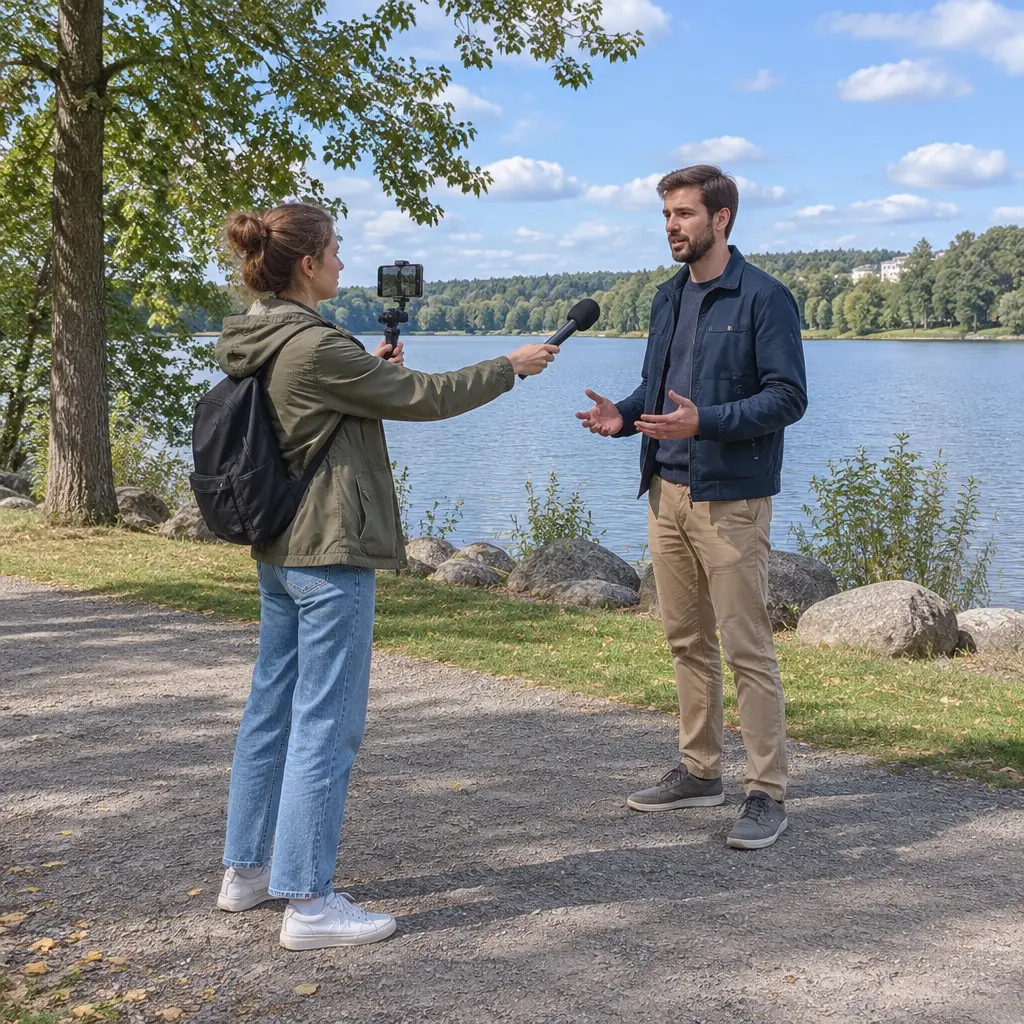
Videojournalism is the reporting and publication of news through moving images, sound, and journalistic storytelling. Its future will be shaped by two closely linked shifts: AI-assisted editing that can speed up transcription, search, captioning, and rough cuts, and mobile production that lets reporters capture and publish professional-quality stories with lightweight devices. These tools can expand speed and access, but they also raise questions about accuracy, authenticity, privacy, and newsroom skills. Their significance is growing as Reuters Institute research documents widespread adoption of generative AI in newsrooms, while mobile devices remain central to how audiences encounter news and how journalists gather it. The trends below explain how these changes work, where they are useful, and what standards help keep reporting trustworthy.
AI editing is reshaping videojournalism workflows
AI-assisted video editing is the use of machine-learning systems to automate or support tasks such as speech recognition, footage search, shot selection, translation, captioning, and assembly. The International Organization for Standardization defines artificial intelligence broadly as the capability of an engineered system to acquire, process, and apply knowledge and skills. In newsroom practice, AI editing is usually a set of assistive functions within a human-led editorial process—not an independent reporter or fact-checker.
The distinction matters because video production contains both repetitive technical work and consequential editorial judgment. Software can find a spoken phrase in hours of footage; it cannot reliably determine whether that phrase is representative, whether a cut changes meaning, or whether a source’s claim is true. The Reuters Institute for the Study of Journalism’s 2024 industry report found that newsroom leaders saw clear potential in using generative AI to automate back-end tasks, while expressing greater caution about applications that directly produce content for audiences. These findings support a model in which AI accelerates production but journalists retain responsibility for selection and verification.
Speech recognition, transcripts, and searchable footage
Automatic speech recognition converts recorded speech into text. When paired with timestamps, transcripts let editors search interviews, press conferences, and field recordings for names, phrases, or topics instead of reviewing every clip linearly. This can shorten the time needed to locate a usable quote and can make large archives easier to reuse.
Transcription accuracy varies with accents, background noise, overlapping speakers, specialist vocabulary, and recording quality. A transcript is therefore a navigation aid, not a source of record: editors should check quotations against the original audio before publication, especially where wording, attribution, or context is disputed. The Associated Press’s guidance on generative AI similarly emphasizes that AI-generated material requires editorial review and should not be treated as verified information simply because a tool produced it.
Automated logging, rough cuts, and repetitive edits
AI logging uses computer vision and audio analysis to label footage—for example, identifying a speaker, scene change, or recurring object. Some tools can also assemble a rough sequence from a script or select clips based on a text prompt. These capabilities are useful for routine tasks such as creating social cutdowns, organizing event footage, or preparing a first assembly for an editor.
Automation is less dependable when a story relies on subtle chronology, visual implication, or emotionally sensitive scenes. A seemingly efficient edit may omit a pause, reaction, or surrounding exchange that changes a viewer’s interpretation. Newsrooms can reduce that risk by preserving original files, documenting material edits, and requiring a journalist to review every AI-generated sequence against the source footage.
Captions, translation, and accessibility
AI captioning creates synchronized text from speech, while machine translation can produce draft subtitles or translated transcripts. Both can help news organizations publish across platforms and languages more quickly, and captions make video more accessible to Deaf and hard-of-hearing viewers as well as people watching without sound.
The World Health Organization estimates that more than 1.5 billion people worldwide experience some degree of hearing loss, making accessible audiovisual publishing a significant public-interest concern. Automated captions still need checking for names, numbers, technical terms, and speaker identification. Translation also requires cultural and editorial review: a literal rendering can miss idiom, uncertainty, or a legally important distinction.
Mobile production is expanding videojournalism’s reach
Mobile journalism, often called “mojo,” is the reporting, recording, editing, and sometimes publishing of news using a smartphone or tablet and related portable equipment. It includes more than phone-camera footage: a mobile workflow may use an external microphone, headphones, a small light, a stabilizer, editing software, and a secure connection for transferring files.
Mobile production lowers the amount of equipment needed to report in the field and can help journalists work quickly in crowded, remote, or rapidly changing situations. The International Telecommunication Union reported that 5.5 billion people—about 68 percent of the world’s population—were using the internet in 2024. The scale of connectivity helps explain why mobile-first reporting and distribution are important, although access, bandwidth, device quality, and data costs remain uneven.
Smartphone capture and compact field kits
A smartphone can capture high-resolution video, record sound, and support basic color correction and editing in a single device. Its small size can make it less conspicuous than a full camera setup, which may be useful for interviews, live updates, and documentary reporting where mobility is essential.
Image resolution alone does not ensure professional results. Clear sound, stable framing, sufficient light, and careful exposure often matter more to a viewer’s experience than a camera’s maximum pixel count. A practical field kit typically prioritizes an external microphone, headphones for monitoring, spare power, secure storage, and a tripod or stabilizer where appropriate. Journalists should also check whether a phone’s settings preserve the original file and whether automatic enhancements could alter evidentiary details.
Live reporting and rapid publishing
Mobile live reporting transmits video directly from a field location to a newsroom or audience, supporting breaking-news updates, interviews, and on-scene explanations. It can reduce the delay between an event and publication, especially when a conventional satellite truck or larger crew is unavailable.
Speed increases the need for verification. A live image may establish what appears to be happening at one moment, but it does not automatically establish location, time, identity, or cause. Newsrooms should verify the source and context of footage, clearly distinguish confirmed facts from developing information, and establish a plan for connectivity failure, battery loss, and personal safety.
Mobile-first formats and audience distribution
Mobile-first video is designed for viewing on phones, often with vertical framing, concise storytelling, captions, and graphics that remain legible on a small screen. This is a production choice rather than a substitute for reporting: the format should serve the story and audience, not dictate what evidence is gathered.
Pew Research Center’s 2024 social media research found that YouTube was used by 83 percent of U.S. adults and Instagram by 47 percent, illustrating the importance of platform-aware distribution. Those figures describe U.S. adults, not global news consumption, and platform reach can change. Editors should therefore prepare adaptable versions when resources allow and retain an accessible, platform-independent version on their own publication channels.
AI and mobile production work best as a combined workflow
The strongest emerging model combines mobile capture with AI-supported organization and editing under human editorial control. A reporter records interviews on a phone, transfers original files to secure storage, uses speech recognition to locate relevant passages, builds an edit in conventional or AI-assisted software, and verifies the final sequence against the original recordings. This workflow links speed to traceability rather than treating automation as a replacement for reporting.
A practical newsroom workflow
- Plan the story, confirm consent and safety considerations, and identify what visual evidence is needed.
- Capture original video and audio, monitor sound, and record essential context such as time, location, and speaker identity.
- Back up files promptly and preserve unaltered originals with appropriate access controls.
- Use AI for transcription, search, caption drafts, or repetitive assembly, while recording which tools were used.
- Verify quotations, translations, captions, chronology, and visual context against the source material.
- Have an editor review the finished piece, including any changes that could affect meaning, before publication.
This approach is especially valuable during breaking news, public meetings, demonstrations, and field reporting with limited crew capacity. It can make a small team more productive, but it does not remove the need for editorial oversight, source protection, or sufficient time to check claims.
Authenticity, provenance, and disclosure
Provenance is the documented history of a media file: where it came from, who handled it, and whether it was altered. As generative tools make synthetic and manipulated media easier to create, newsrooms need clear records of original footage and edits. The Coalition for Content Provenance and Authenticity’s technical standards provide one approach to recording the origin and modification history of digital content, though provenance metadata cannot by itself prove that a scene is truthful.
A responsible policy should distinguish routine technical adjustments—such as trimming, exposure correction, or audio cleanup—from changes that create, remove, or materially alter events. If AI generates or substantially changes visual content, audiences should receive clear disclosure, and the newsroom should avoid presenting synthetic imagery as documentary evidence. The Society of Professional Journalists’ Code of Ethics offers a useful foundation: seek truth, minimize harm, and take responsibility for the accuracy of published work.
Privacy, security, and staff training
Mobile reporting can expose sensitive data through cloud backups, location metadata, messaging apps, or third-party editing services. Uploading interview audio to an external AI system may also disclose confidential information. Newsrooms should assess vendor data-retention terms, restrict access to sensitive files, remove location metadata when appropriate, and use approved tools for unpublished or vulnerable-source material.
Training should cover both technical and editorial skills: audio capture, framing, lighting, mobile security, verification, copyright, accessibility, and AI limitations. The goal is not simply to teach journalists how to operate a new tool, but to help them recognize when it is unsuitable and how its use may affect a source or audience.
Conclusion: trustworthy videojournalism depends on human judgment
AI editing can make transcription, footage search, captioning, translation, and repetitive assembly faster. Mobile production can help journalists gather and distribute visual reporting with lighter, more flexible equipment. Together, these trends offer newsrooms practical ways to increase speed, accessibility, and reach, but neither technology guarantees accuracy or trust.
The durable advantage will come from pairing efficient tools with verified source material, transparent editing, secure workflows, accessibility, and accountable human decisions. News organizations should test AI systems carefully, train staff, document material changes, and preserve original footage. Journalists and readers alike can strengthen video reporting by asking how images were gathered, edited, verified, and disclosed.
Sources: Reuters Institute for the Study of Journalism, Journalism, Media, and Technology Trends and Predictions 2024, https://reutersinstitute.politics.ox.ac.uk/journalism-media-and-technology-trends-and-predictions-2024; International Organization for Standardization, ISO/IEC 22989:2022 Information technology—Artificial intelligence—Artificial intelligence concepts and terminology, https://www.iso.org/standard/74296.html; Associated Press, Standards Around Generative AI, https://www.ap.org/the-definitive-source/behind-the-news/standards-around-generative-ai/; World Health Organization, Deafness and hearing loss, https://www.who.int/news-room/fact-sheets/detail/deafness-and-hearing-loss; International Telecommunication Union, Facts and Figures 2024, https://www.itu.int/itu-d/reports/statistics/facts-figures-2024/; Pew Research Center, Americans’ Social Media Use, 2024, https://www.pewresearch.org/internet/2024/12/12/americans-social-media-use/; Coalition for Content Provenance and Authenticity, C2PA Technical Specification, https://c2pa.org/specifications/specifications/2.1/index.html; Society of Professional Journalists, SPJ Code of Ethics, https://www.spj.org/ethicscode.asp.