
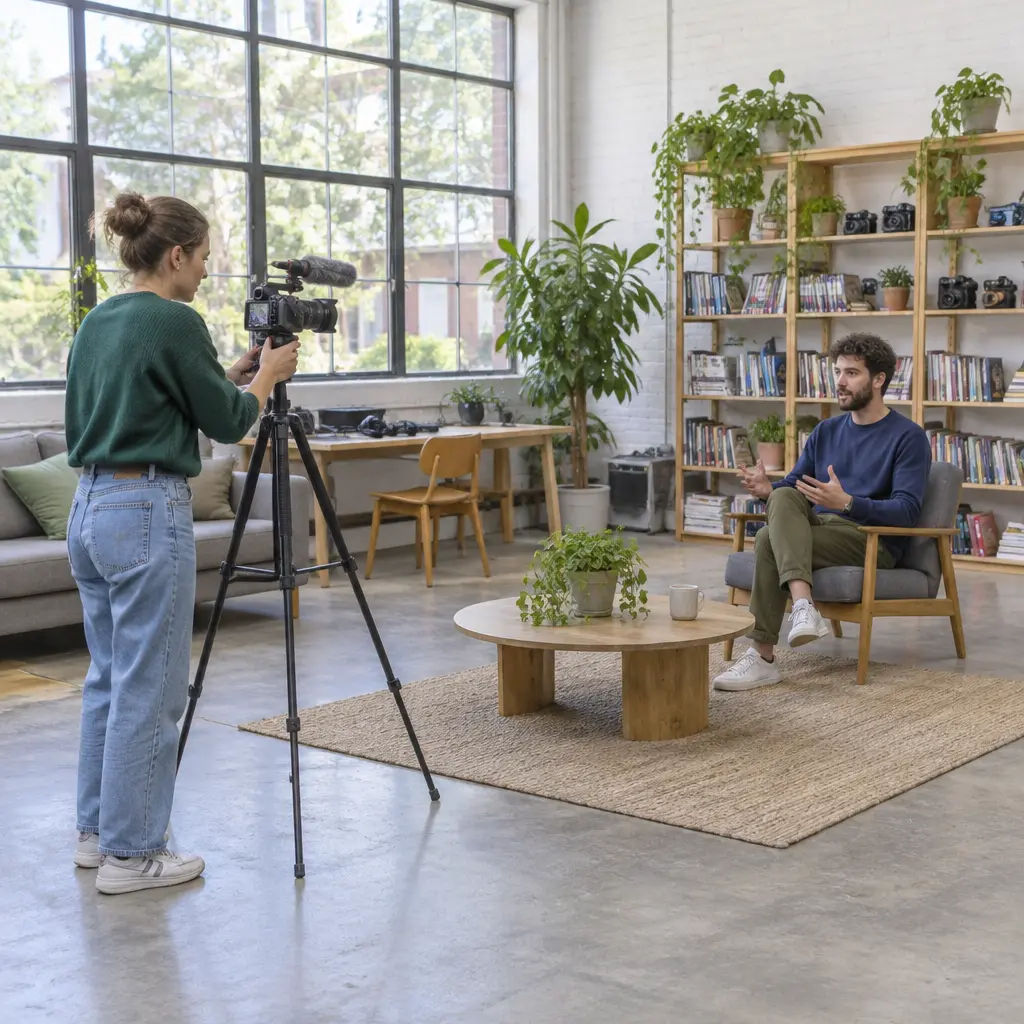
Videojournalism skills transfer to careers in digital media, communications, documentary production, and marketing because they combine reporting, visual storytelling, interviewing, editing, and deadline management. Videojournalism is the practice of researching, reporting, filming, and often editing news stories, frequently with one journalist performing several roles. The U.S. Bureau of Labor Statistics reports that employment of film and video editors and camera operators is projected to grow 3% from 2023 to 2033, while employment of public relations specialists is projected to grow 6% over the same period. Those figures point to demand across both production and communication work. The transferable skills fall into four connected groups: editorial research, visual production, audience-focused storytelling, and professional collaboration.
Videojournalism skills as transferable media capabilities
A transferable skill is a capability that can be applied in more than one role or industry. In videojournalism, this means that reporting and production habits developed for news can also support work in documentary filmmaking, corporate communications, social media, public relations, and online publishing. The National Association of Broadcasters describes newsroom work as a combination of gathering information, creating content, and delivering it through changing platforms; those activities are relevant well beyond a traditional television newsroom.
Videojournalists commonly work across several stages of a story: identifying a subject, verifying facts, interviewing sources, recording images and sound, editing footage, and preparing content for publication. This broad role creates a portfolio of skills rather than a single technical specialty. Its value is particularly clear as audiences consume news and branded content through websites, mobile devices, and social platforms as well as broadcast outlets.
Reporting and verification
Reporting is the disciplined collection and checking of information before it is presented as fact. Videojournalists develop this skill by researching documents, identifying knowledgeable sources, asking follow-up questions, and comparing claims against evidence. These practices transfer directly to content research, investigative production, fact-checking, and communications roles that require accurate, defensible messaging.
Verification matters especially in a crowded information environment. The Reuters Institute for the Study of Journalism’s Digital News Report 2024 surveyed news consumers in 47 markets and found persistent concern about distinguishing trustworthy from untrustworthy online news. A media professional who can trace a claim to its source, distinguish observation from inference, and correct an error transparently brings a valuable standard to any publishing team.
Interviewing and source relationships
Interviewing is a structured conversation used to gather information, perspective, and usable material. Videojournalists learn to prepare focused questions, listen for important details, ask clarifying follow-ups, and help interviewees feel comfortable on camera. These abilities transfer to podcasting, documentary work, customer research, internal communications, and public relations.
The skill is not simply asking questions: it also involves consent, context, and fair representation. In a corporate or nonprofit setting, those habits help communicators capture credible employee, customer, or community perspectives without losing the speaker’s meaning. In documentary production, careful relationship-building can make the difference between a superficial interview and a detailed, trustworthy account.
Visual storytelling and production skills in other media careers
Visual storytelling uses images, sound, sequencing, and narration to make information understandable and emotionally engaging. Videojournalists practice it by deciding what viewers need to see, selecting relevant footage, and shaping a coherent sequence from recorded material. The same capability supports video editing, documentary production, social content, e-learning, and marketing.
The U.S. Bureau of Labor Statistics groups film and video editors and camera operators among the occupations that create and manipulate moving images. Its Occupational Outlook Handbook projects 3% employment growth for the combined occupational group from 2023 to 2033 and estimates about 8,400 openings per year on average, including openings caused by workers leaving the occupation. Videojournalism experience can help candidates demonstrate practical production competence, though specialized roles may also require deeper training in animation, lighting, or advanced post-production.
Camera operation, composition, and sound
Camera operation is the ability to record stable, purposeful images using framing, focus, exposure, and movement appropriate to a story. Videojournalists also learn that usable sound is essential: clear speech, controlled background noise, and intentional ambient audio improve comprehension and production quality. These foundational skills apply to field production, event coverage, interviews, livestreams, and social video.
A simple visual sequence—an establishing shot, a medium view, and a close-up—can help an editor convey location, action, and detail. In other media careers, that same planning reduces gaps in coverage and makes footage easier to edit. A journalist who can capture clean audio and varied, relevant shots is better prepared to work independently or contribute effectively to a production crew.
Editing and narrative structure
Editing is the selection and arrangement of material into a clear, accurate, and engaging sequence. Videojournalists learn to organize footage, build a beginning-middle-end structure, balance narration with natural sound, and remove material that does not advance the story. These skills transfer to branded video, short documentaries, podcasts with video, training materials, and digital news packages.
A strong edit is not only a technical assembly; it is an editorial argument about what matters and in what order. That judgment helps media professionals maintain clarity while adapting a story to different formats. For example, a long interview can be shaped into a full documentary segment, a short social clip, and a written summary, provided each version preserves the accuracy and context of the original material.
Multiplatform publishing and audience adaptation
Multiplatform publishing means adapting content for different channels, formats, and audience expectations. A videojournalist may prepare a broadcast package, a vertical mobile clip, captions, a thumbnail, and a concise written description from the same reporting. This experience transfers to social media production, digital publishing, and content strategy.
The Pew Research Center’s 2024 social media research found that 53% of U.S. adults say they at least sometimes get news from social media. That figure underscores why media workers need to understand how content travels outside traditional broadcast settings. Platform adaptation should change presentation—not the underlying facts—and should account for accessibility through captions, readable text, and clear audio.
Audience communication and collaboration beyond the newsroom
Videojournalism also develops communication and project-management capabilities that are useful in public relations, marketing, nonprofit communications, and production teams. The work requires translating complex information into accessible stories while coordinating with sources, editors, producers, and sometimes legal or technical specialists. These habits are valuable wherever content must be accurate, timely, and understandable.
Clear communication for public relations and marketing
Clear communication is the ability to explain a subject in language and formats suited to an intended audience. Videojournalists practice this by turning specialist knowledge into concise scripts, visuals, and interviews without losing essential meaning. In public relations, the same skill supports media materials, executive interviews, campaign videos, and crisis updates.
The Bureau of Labor Statistics projects 6% growth in employment for public relations specialists from 2023 to 2033, with about 27,100 openings per year on average. This is not a forecast specifically for videojournalists, but it illustrates a related career area where storytelling, research, and audience awareness are useful. The ethical distinction is important: journalism seeks independent reporting, while organizational communications represent a client or employer. Professionals moving between them should be transparent about purpose and avoid presenting promotional content as independent news.
Deadlines, planning, and teamwork
Deadline management is the ability to plan work, prioritize essential tasks, and deliver a complete product on schedule. A videojournalist may coordinate interviews, travel, filming, editing, captioning, and publication under tight time constraints. This experience transfers to campaign production, agency work, event media, and documentary projects.
The work also builds collaboration. Even when one person performs several roles, a finished story may depend on a producer’s direction, an editor’s feedback, a source’s availability, and a technical team’s support. The U.S. Bureau of Labor Statistics notes that film and video editors and camera operators often work with producers and directors, and that production schedules may involve long or irregular hours. Communicating progress, identifying risks early, and responding constructively to revisions are therefore practical career assets.
Ethics, accessibility, and responsible storytelling
Responsible storytelling means gathering and presenting material with accuracy, fairness, appropriate consent, and attention to potential harm. Videojournalists must consider how editing changes meaning, whether a scene is adequately contextualized, and whether a person understands how recorded material may be used. These considerations apply to documentary work, brand storytelling, nonprofit campaigns, and internal communications.
Accessibility is part of responsible production. Captions help viewers who are deaf or hard of hearing, support people watching without sound, and can improve comprehension for audiences using a second language. The World Wide Web Consortium’s Web Content Accessibility Guidelines recommend captions for prerecorded synchronized media at Level A and captions for live synchronized media at Level AA. Video professionals who plan for captions, readable graphics, and clear audio make content more usable across audiences and platforms.
How to present videojournalism skills to employers
A portfolio translates experience into evidence. Candidates should present selected work samples alongside a short explanation of their role, the reporting or production challenge, the tools used, and the outcome. This helps employers distinguish an individual’s contribution from the work of a larger team.
- Organize samples by capability, such as reporting, interviewing, camera work, editing, or platform adaptation.
- Include a range of formats, such as a full news package, a short vertical video, an interview, and a captioned explainer.
- Explain ethical decisions, verification steps, and how revisions or deadlines were handled.
- Tailor the portfolio to the target career: emphasize narrative work for documentary roles, audience and campaign goals for marketing, or accuracy and sourcing for editorial roles.
- Describe measurable results only when they are documented, such as audience reach, completion rates, or delivery time.
A useful visual comparison would be a chart mapping videojournalism competencies—research, interviewing, filming, editing, accessibility, and deadline management—to related roles in documentary, public relations, social media, and digital publishing. Such a chart can help job seekers identify both existing strengths and skills to develop next.
Conclusion: videojournalism skills support adaptable media careers
Videojournalism builds a connected set of capabilities: reporting and verification establish trust; interviewing and source relationships produce useful material; visual storytelling, camera work, and editing shape that material into a coherent story; and multiplatform publishing makes it accessible to different audiences. Communication, teamwork, ethics, and deadline management extend the value of those skills into public relations, marketing, documentary production, and digital media.
Employment projections do not guarantee a particular career outcome, but Bureau of Labor Statistics data show continuing opportunities in both video production and public relations. To make the transition, build a focused portfolio, explain your contribution to each project, and identify any role-specific tools or knowledge you still need. Further reading from the Bureau of Labor Statistics, Pew Research Center, Reuters Institute, and the World Wide Web Consortium can help you connect career planning with current industry and accessibility guidance.
Sources: U.S. Bureau of Labor Statistics, Film and Video Editors and Camera Operators, https://www.bls.gov/ooh/media-and-communication/film-and-video-editors-and-camera-operators.htm; U.S. Bureau of Labor Statistics, Public Relations Specialists, https://www.bls.gov/ooh/media-and-communication/public-relations-specialists.htm; Reuters Institute for the Study of Journalism, Digital News Report 2024, https://reutersinstitute.politics.ox.ac.uk/digital-news-report/2024; Pew Research Center, Social Media and News Fact Sheet, https://www.pewresearch.org/journalism/fact-sheet/social-media-and-news-fact-sheet/; World Wide Web Consortium, Web Content Accessibility Guidelines (WCAG) 2.2, https://www.w3.org/TR/WCAG22/; National Association of Broadcasters, About NAB, https://www.nab.org/about/